
What To Do With The Stars
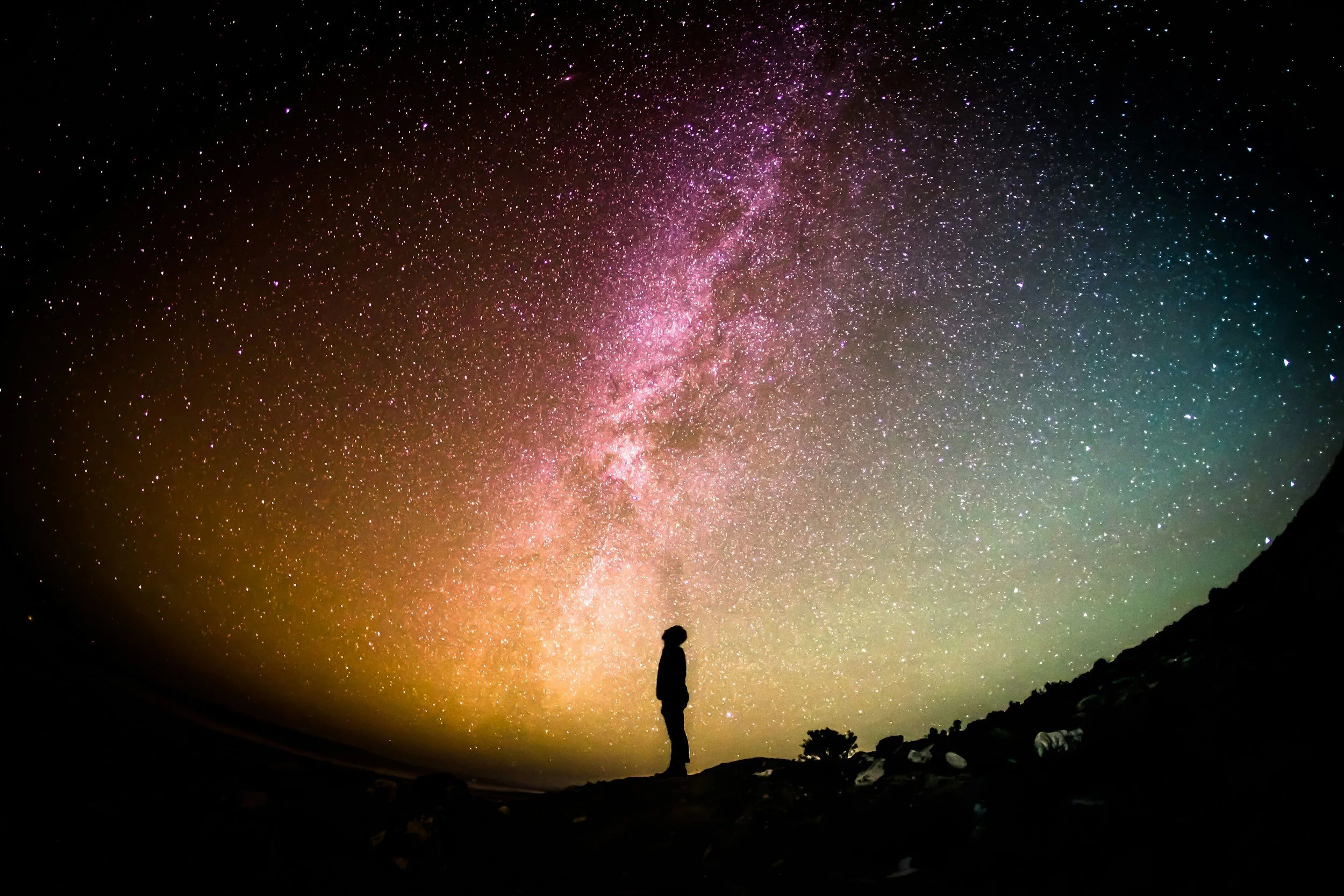
Stargazing can be done with or without whimsy. The last time I did it was the middle of August. The town, Captain Kid, was safe and low-energy enough for me to take as many evening strolls on my own as I wished. I remember that it was a Thursday when I decided to lay down in a patch of high, fuzzy grass for a session of stargazing. The specks appeared one by one, until the sky went from endless black to an ink-blue rug, embroidered with an infinite number of diamonds. The view is consistent but it never gets boring for me.
The glamour of the stars amazed me even when I was too young to know what they actually were. Before I was a tween, I thought stars were literal magic. I imagined them as boulder-sized clusters of golden dust, pulsing with power that was quite literally out of my world. I wanted to own one, perhaps put one in a sac. My ultimate goal was to touch one so I could have their “galactic energy,” as I so often said to whatever adult that would listen. Pressing my hand to a star would make its magic surge up my arm and to the tips of my hair, almost to my hips even back then, with white-hot coursing through my bones. I also wanted to be among them, even just for a bit. Floating by them like Superman or riding a piece of furniture like Aladdin all the way through the atmosphere I didn’t know existed yet was a common daydream for me.
A decade later, my belief in magic is different in the sense that it remained appropriate for my age: iced coffees and full reproductive rights. My pubescent whimsy now sits in my long-term memory like a picture book on a shelf in an attic. I shelved it there when I learned what stars actually were from one of the countless educational episode programs that were the only digital entertainment my parents permitted: gargantuan masses of burning hydrogen and helium.
At nearly seventeen years old, I can now analyze this part of my life as if it was an English assignment. Besides my first idea of stars being a classic example of childhood naivete, I think it was a uniquely human thing; to see something glamorously attention-grabbing but vague enough for making one’s imagination run wild with it. I also think that stars are excellent metaphors for dreams as a whole: things that are impossibly far away and glittering in their unreachable glory.
Sometimes, elementary-school Astrid Julia Shivers sneaks out after bedtime—eight-thirty sharp for her and ten for me, but only on weekdays—and toddles out to find me. She is quite cute, her skin not yet colonized by acne, so I let her read a picture book in my lap while I write and work. The five-pointed stars she draws on my papers and thighs are sloppy but never fail to make me smile.